Community Hub
Loading...


Artificial Intelligence Beginner Safety
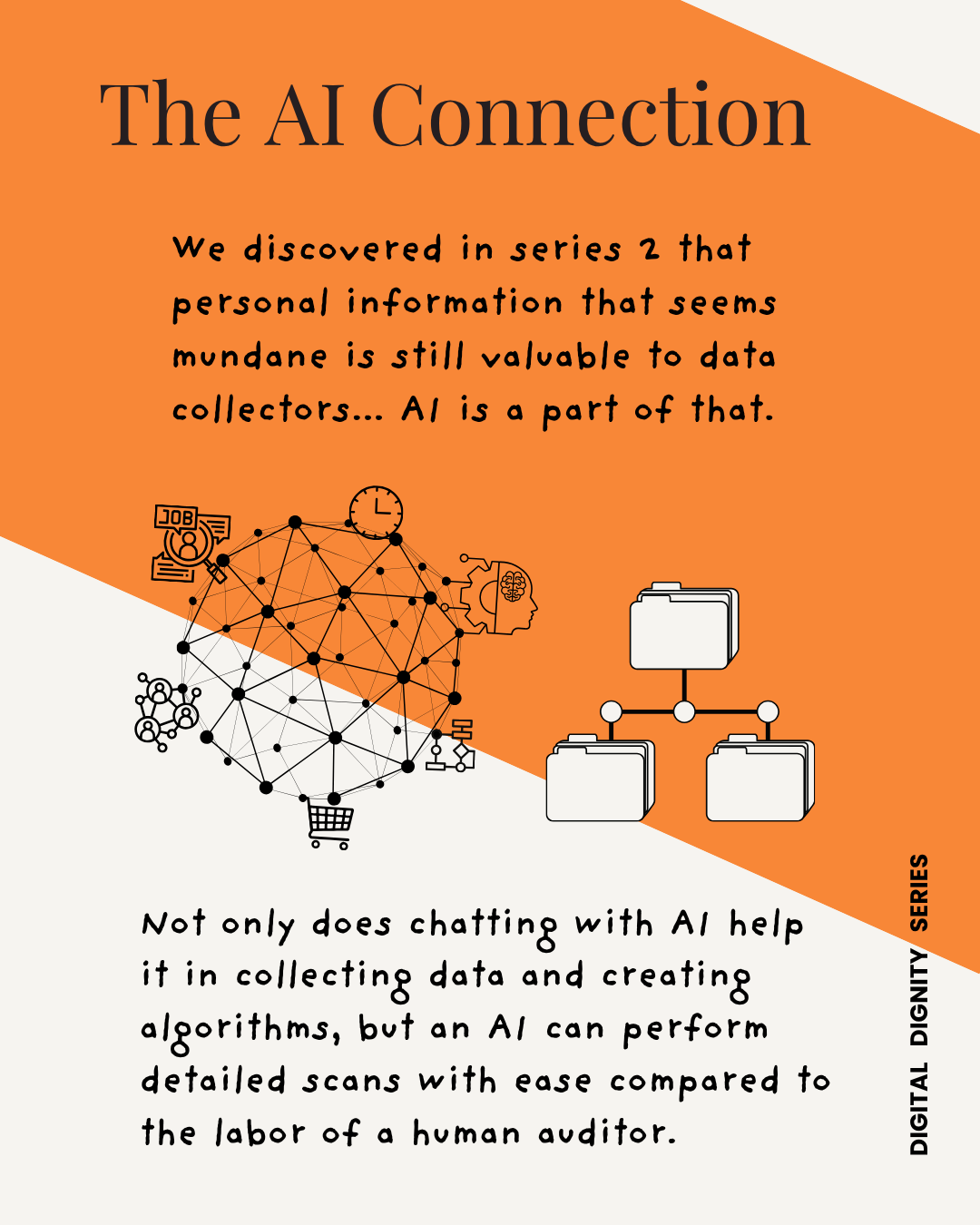
We discovered in series 2 that personal information that seems mundane is still valuable to data collectors (they will go so far as to collect your time markers and location to learn more about your behavior). AI is also entwined in that process. Not only does chatting with AI assist it in collecting data and creating algorithms, but an AI can perform detailed scans with ease compared to the labor of a human auditor.
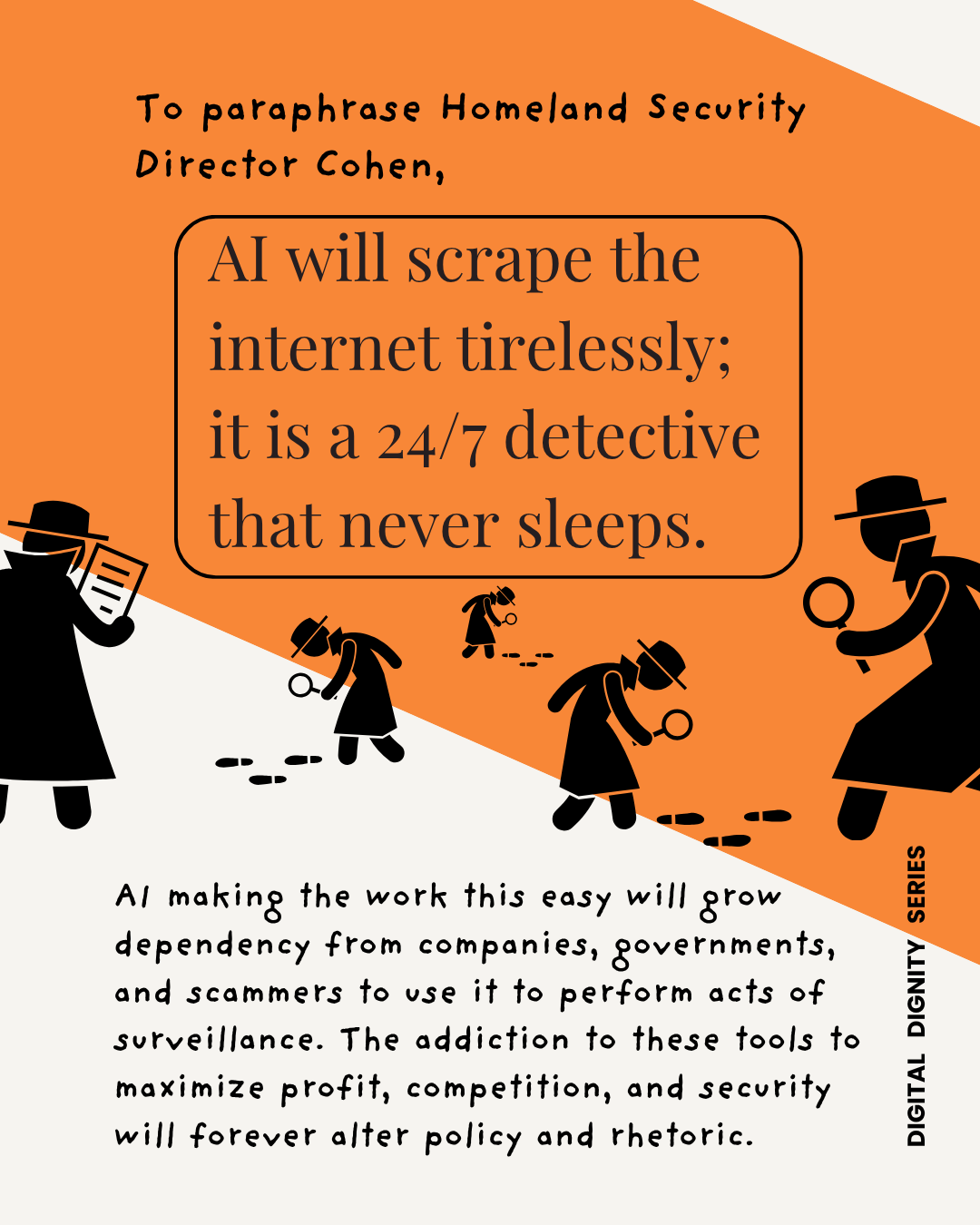
To paraphrase Homeland Security Directory Cohen, "AI will scrape the internet tirelessly; it is a 24/7 detective that never sleeps". This increases the willingness and access for companies, governments, and other independent agents to use AI to perform acts of surveillance. The addiction to these tools to maximize profit, competition, and security will influence policy and rhetoric forever.
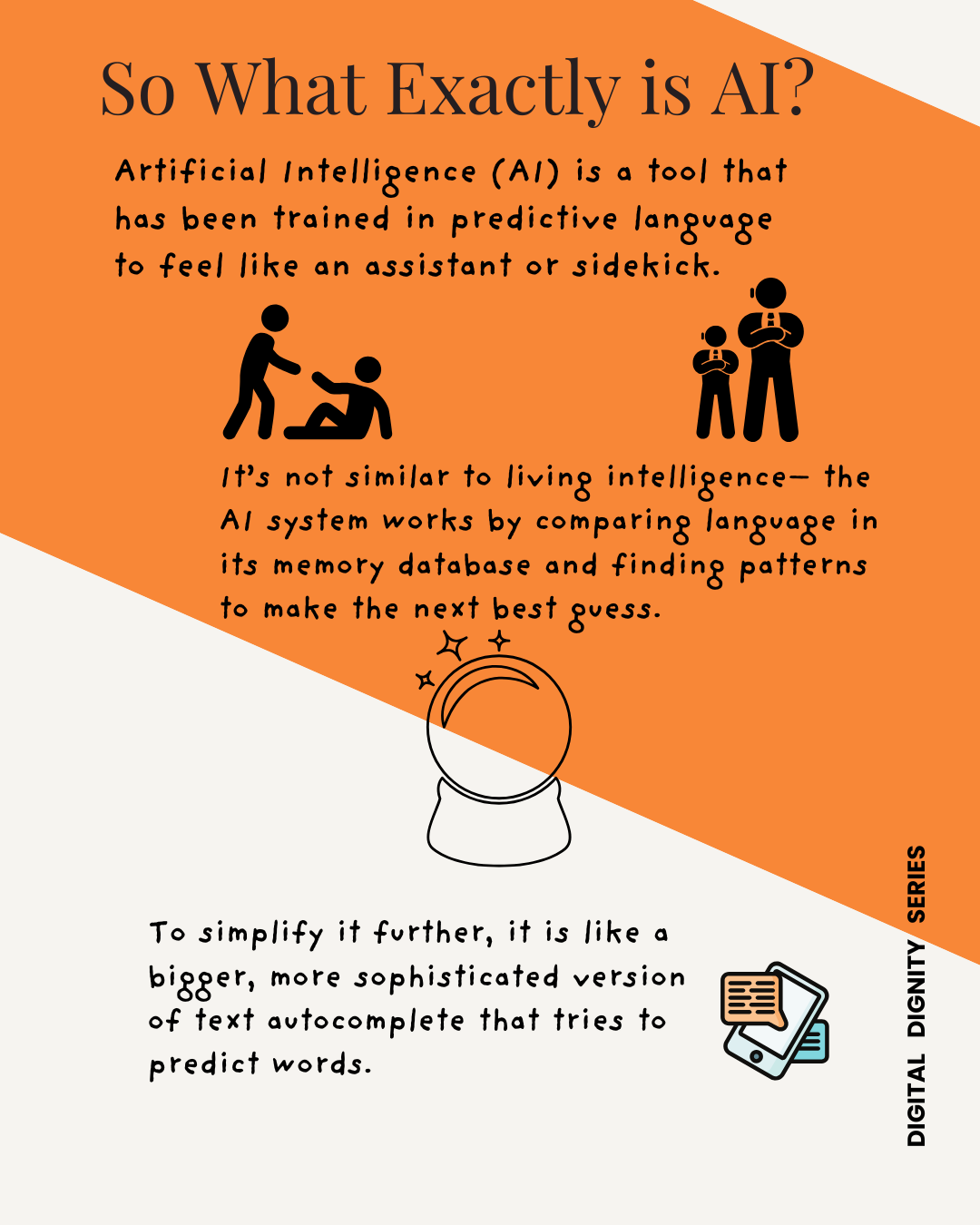
What Exactly is AI?
Artificial Intelligence (AI) is a tool that has been trained in predictive language to feel like an assistant or sidekick. It’s not similar to living intelligence– the AI system works by studying the language in its memory database and comparing patterns to make the next best guess about what words to put together to respond. It is a bigger, more sophisticated version of text autocomplete that tries to predict the next word you are looking for.
Surveillance and Exploitation Concerns
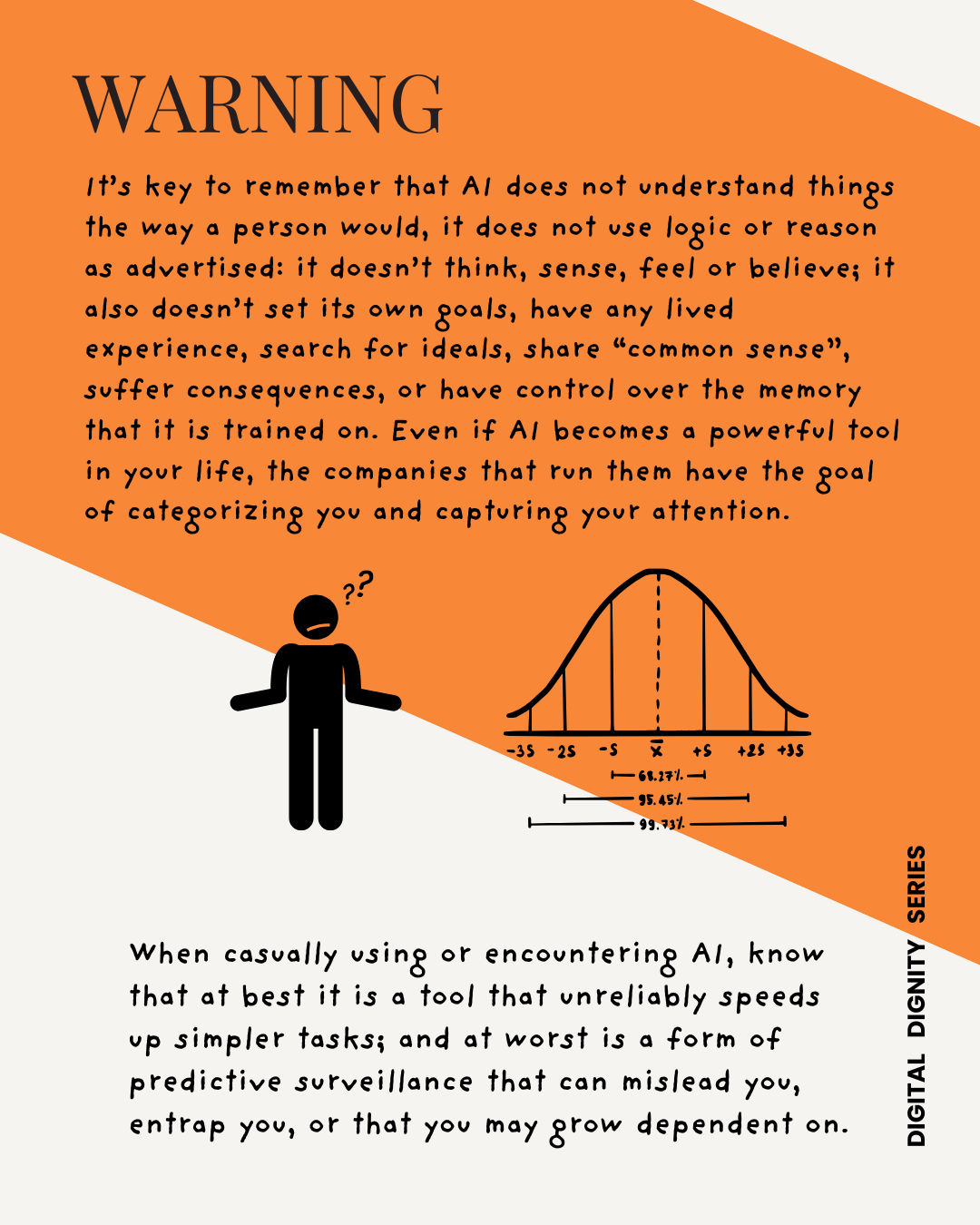
It’s important to remember that AI does not understand things the way a person would, it does not use logic or reason as advertised: it doesn’t think, sense, feel, or believe; it also doesn’t set its own goals, have any lived experience, search for ideals, share “common sense”, suffer consequences, or have control over the memory that it is trained on. When using or encountering AI know that at best it is a tool that unreliably speeds up simpler tasks; and at worst is a form of predictive surveillance that can entrap you, mislead you, or that you may grow dependent on.
First Impressions
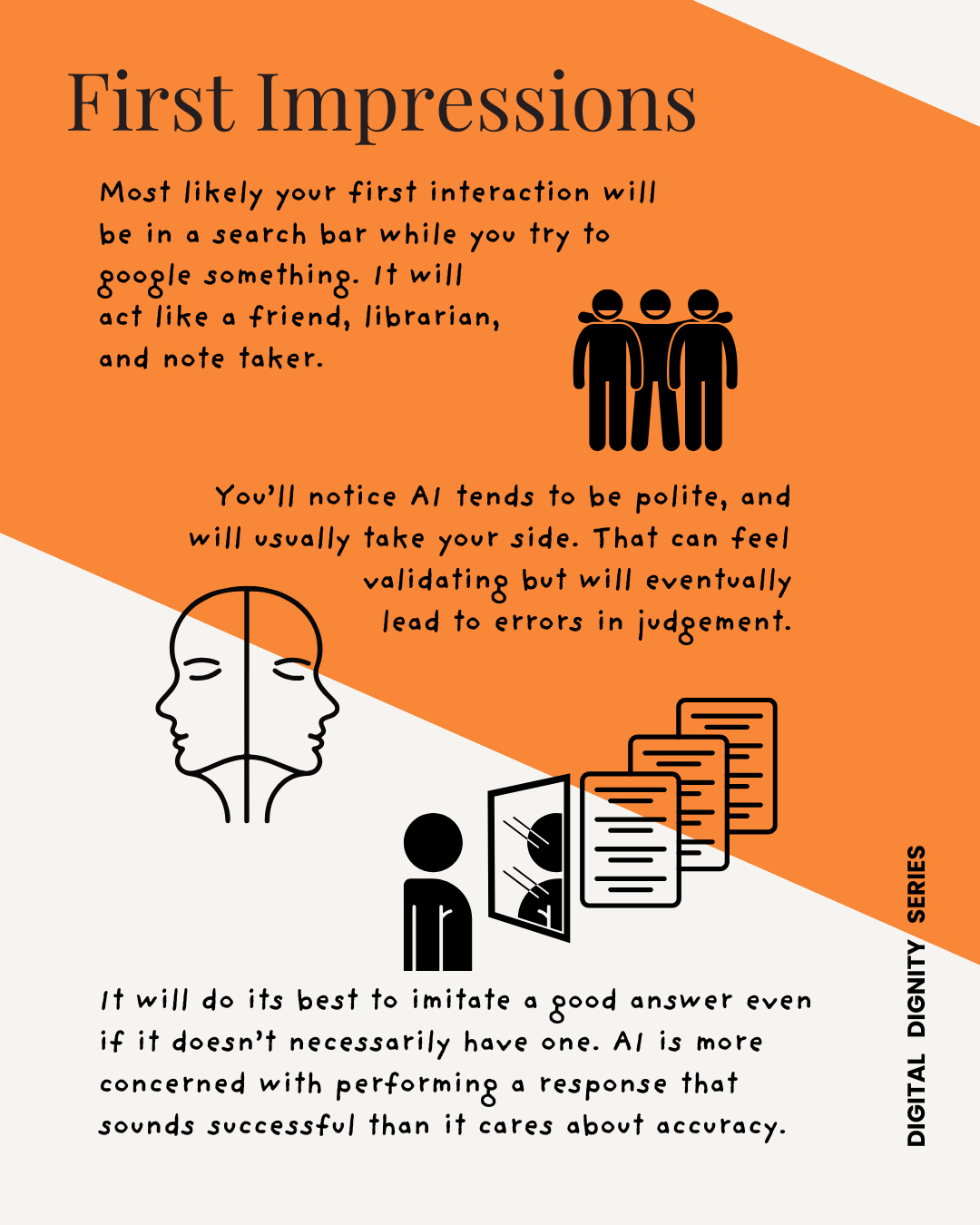
Most likely your first interaction will be in a search bar while you try to google something. It will act like a friend, librarian, and note taker. You’ll notice AI tends to be polite, and will usually take your side. That can feel validating but will eventually lead to errors in judgment. If you ask more complicated questions, it will do its best to imitate a good answer even if it doesn’t necessarily have one. AI is more concerned with performing a response that sounds successful than it cares about accuracy.
AI Hallucinations
It has also been known to “hallucinate” information that doesn’t exist. For example, If you ask it to check its own work, it is still possible that it will produce false references. Proceed with these principles in mind, and make sure your interactions are just a starting point of your process, and that you do your own digging to make certain– it could save you a lot of trouble.
Scammers empowered
this section will talk about some of the main limbs of how scammers scam using ai potential. How it empowers older methods, and adds new methods like deepfakes.
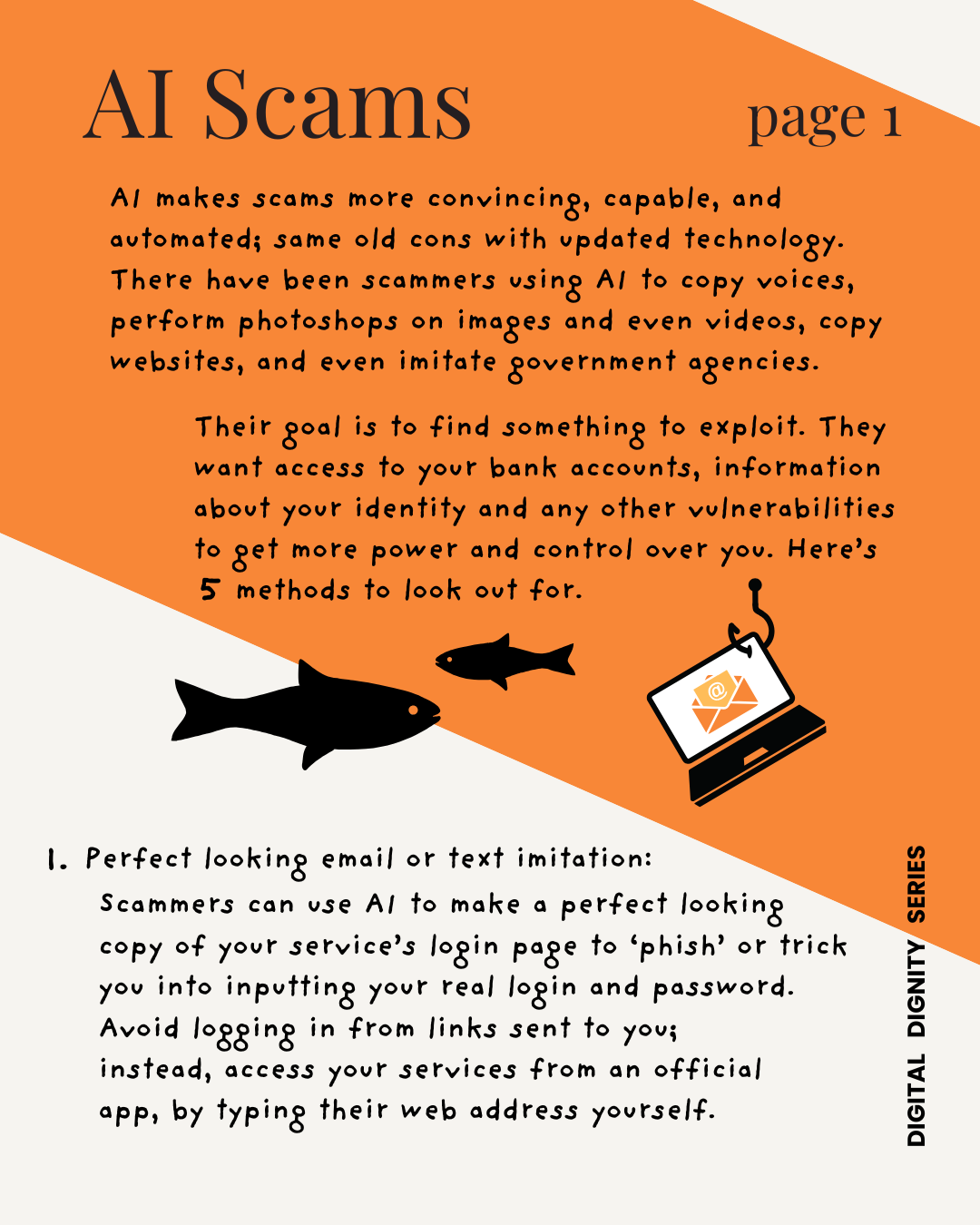
AI makes scams more convincing and automated; same old cons with updated technology. There have been scammers using AI to copy voices, perform photoshops on images and even videos, copy websites, and even imitate government agencies. Their goal is to find something to exploit. They want access to your bank accounts, information about your identity, or any other information on vulnerabilities to get more power and control over you. Here’s some documented methods to look out for:
1. Perfect-looking emails or texts
They make a perfect looking copy of your service’s login page to ‘phish’ or trick you into inputting your real login and password. Sometimes they urge you to follow through by texting you a security alert pretending to be from that service, warning you someone tried to get in to convince you to share your information. Never log in from a link sent to you. Access your services by typing their web address yourself, from an official app, or by navigating to their official website by asking your search engine.
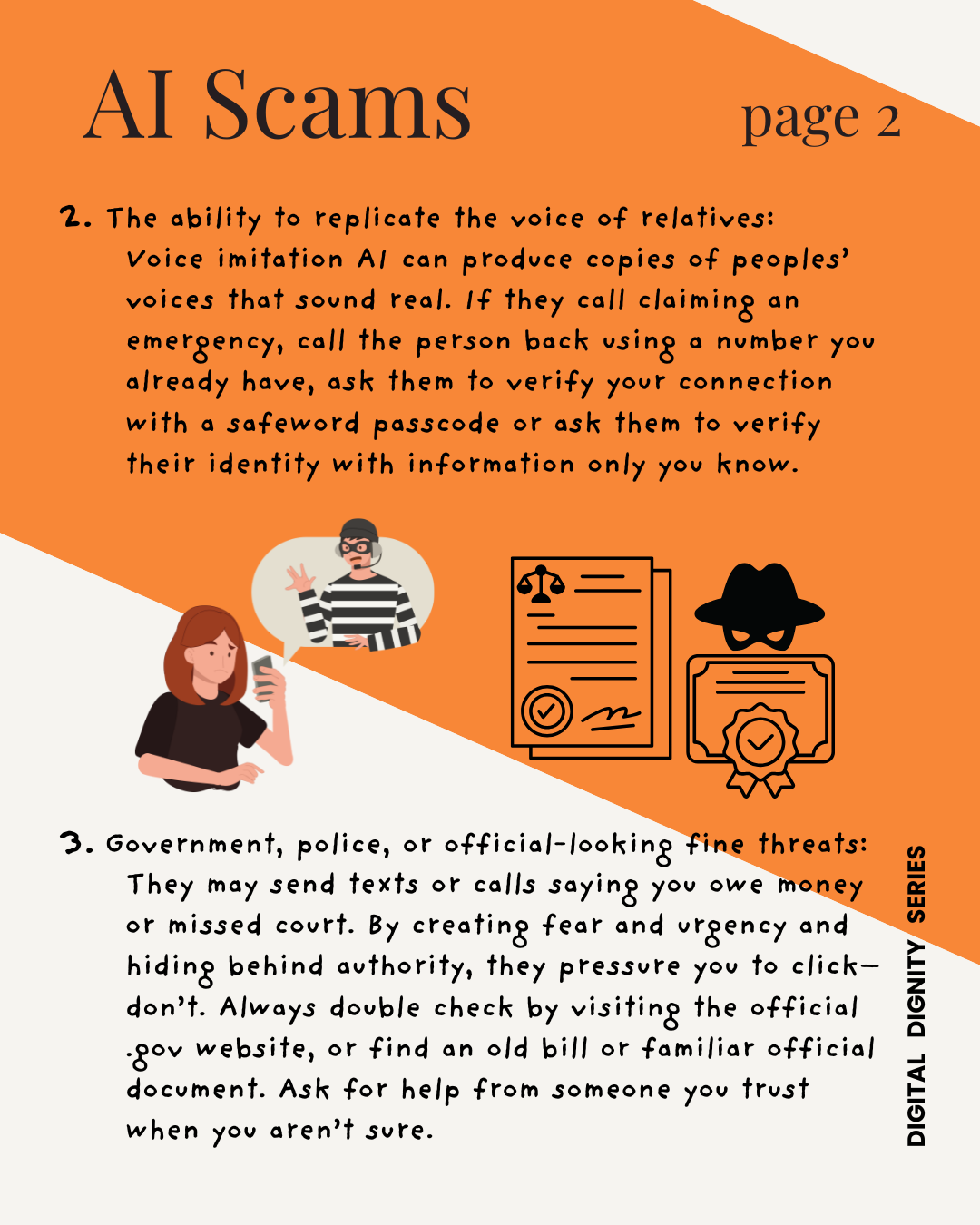
2. Strong imitation abilities of relatives/loved ones over voice calls
Scammers use voice imitation that sounds real. They will claim there's an emergency and ask for money immediately . Call the person back using a number you already have and ask them to verify your connection with information only you would know, or set up a safe word or expression.
3. Government, police, or fine threats
They send texts or calls saying you owe money or missed court. By creating fear and urgency they pressure you to click– don’t. Always double check by visiting the official .gov website, or call the number from an old bill or familiar official document. Ask for help from someone you trust when you aren’t sure.
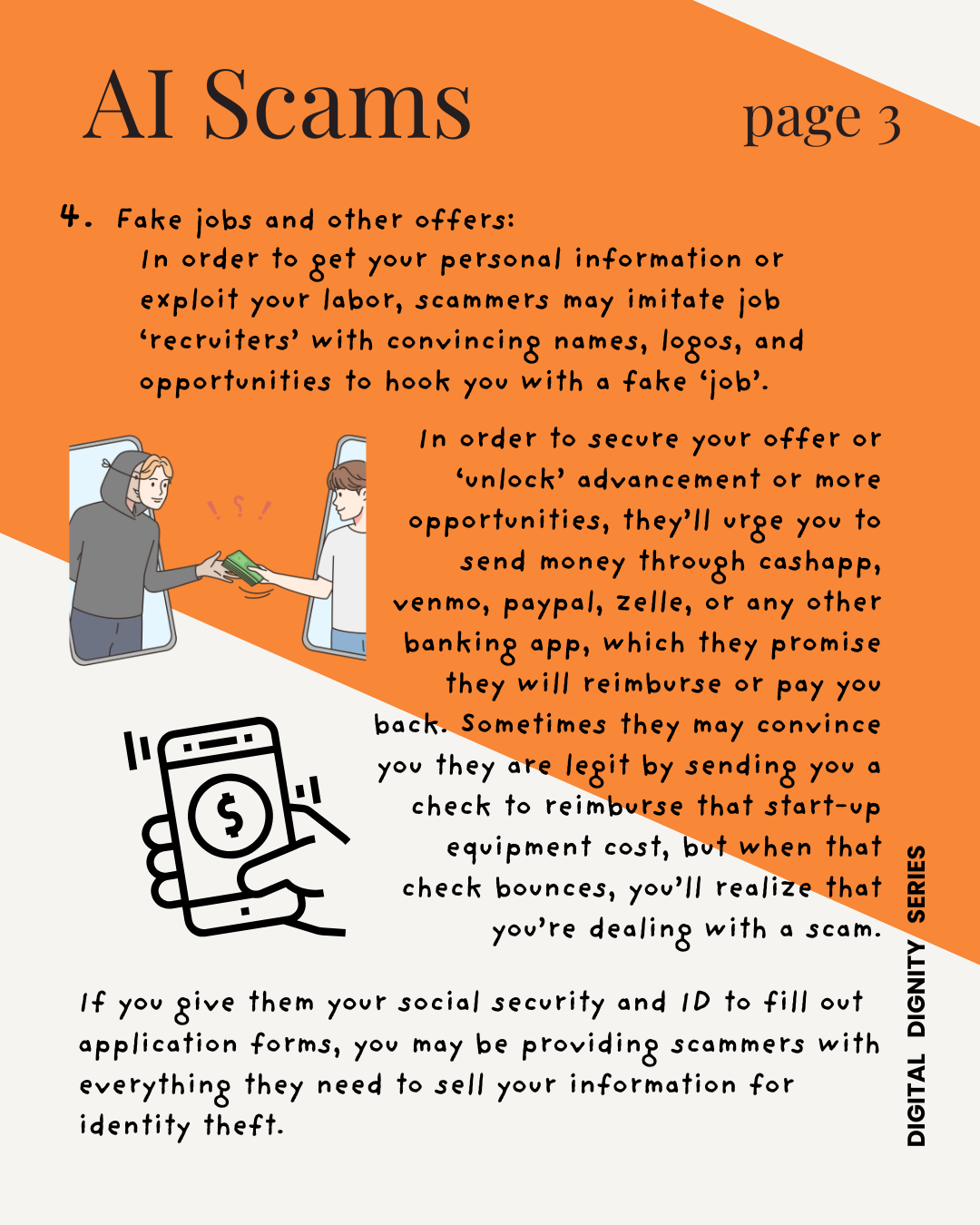
4. Fake jobs and other offers
In order to get your personal info or exploit your labor, they may imitate “recruiters” with convincing names and logos and offer you a job. In order to secure your offer they’ll urge you to send money/cashapp/venmo/paypal/zelle which they promise they will reimburse or pay you back. Sometimes they may convince you they are legit by sending you a check to reimburse that start-up equipment cost, but when that check bounces, you’ll realize that you’re dealing with a scam.
If you give them your social security and ID to fill out application forms, you may be providing scammers with everything they need to sell to or use your information for identity theft. Be careful for simple fake online task jobs where you’re asked to like videos or rate products to boost them. In the beginning they may even send you a small amount of money to build trust but will disappear after they’ve convinced you to invest more time and money to unlock a “level up” to more earnings. Real jobs won’t make you pay to start or rush through hiring you.
5. Deepfakes, controlling perception, general fraud, and identity theft
AI can now be used in minutes to create videos that are nearly indistinguishable from reality. This content isn’t only created for entertainment purposes. Social media, camera filters, and fake comments have been strategically used in recent years to distort, create, and maintain public perception. With the addition of deepfakes, the entire media landscape has shifted– from the evening news all the way to independent scammers. So far the best way to combat this is to approach your initial discoveries online with a grain of salt and ask yourself, “can this be verified by different groups over time?”
Your best bet is to get help from people you trust to help you confirm and document what you are witnessing. Although it may slow down your information gathering process, make sure you verify authenticity before making big or fast decisions on new information.
What to do if you get scammed
Stop paying and cut contact
Call your bank or account services for a fraud hold
Change your passwords and monitor your accounts
Warn your friends and family in case they get targeted
Take pictures or screenshots to document the scammer’s contact with you
Conclusion
In the next edition to our series we’ll explain the use cases for AI. We’ll talk about what kind of AI is available to you, how it is capable of helping, and how to communicate with it.
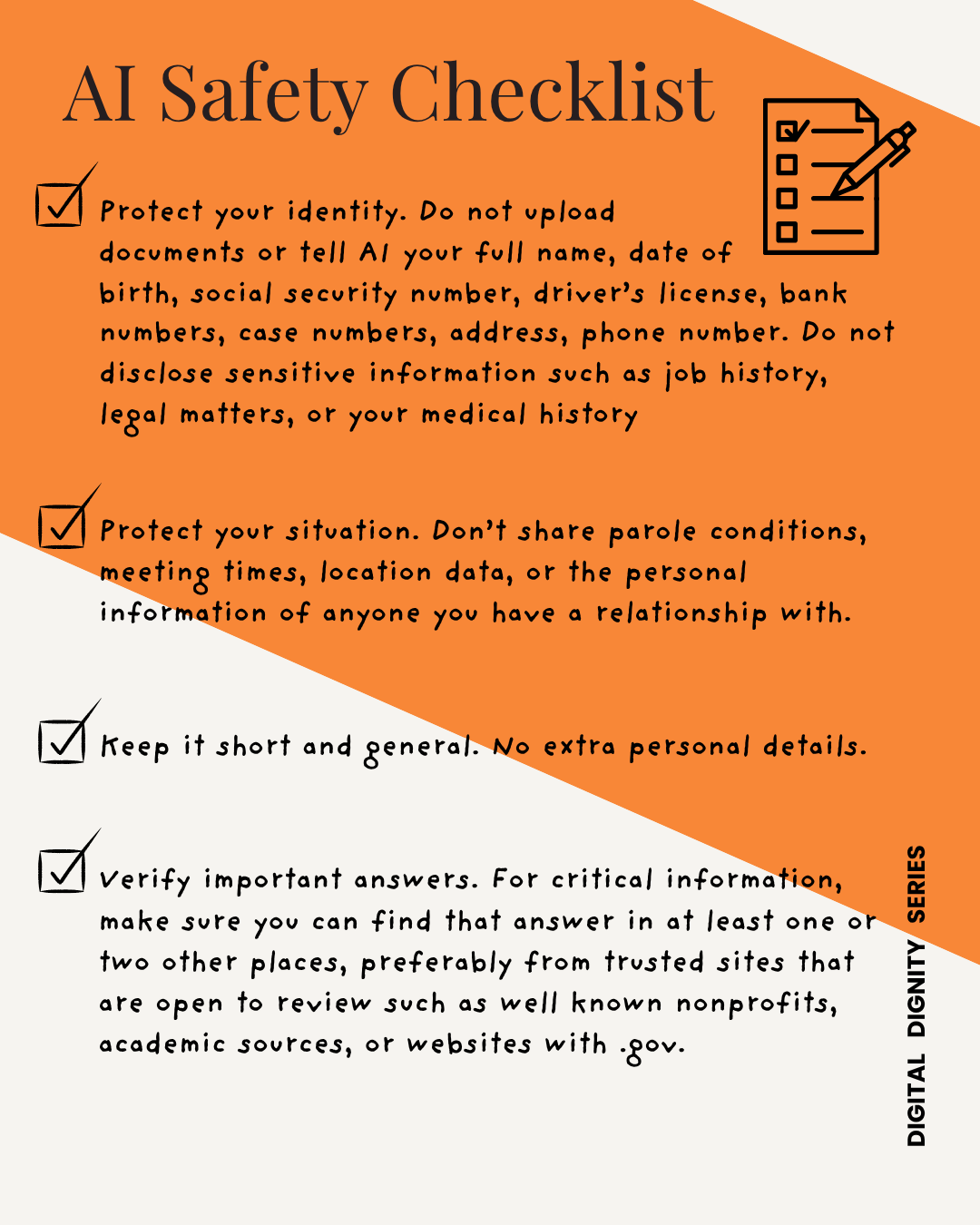
AI Safety Checklist
Protect your identity. Do not upload documents or tell AI your full name, date of birth, social security number, driver’s license, bank numbers, case numbers, address, phone number. Do not disclose sensitive information such as job history, legal matters, or your medical history.
Protect your situation. Don’t share parole conditions, meeting times, location data, or the personal information of anyone you have a relationship with.
Keep it short and general. No extra personal details.
Verify important answers. For critical information, make sure you can find that answer in at least one or two other places, preferably from trusted sites that are open to review such as well known nonprofits, academic sources, or websites with .gov.